Payroll Taxes, Costs & Benefits Paid by Employers

In addition to salaries and wages, the employer will incur some or all of the following payroll-related expenses:
  1. Employer portion of Social Security tax
  2. Employer portion of Medicare tax
  3. State unemployment tax
  4. Federal unemployment tax
  5. Worker compensation insurance
  6. Employer portion of insurance (health, dental, vision, life, disability)
  7. Employer paid holidays, vacations, and sick days
  8. Employer contributions toward 401(k), savings plans, & profit-sharing plans
  9. Employer contributions to pension plans
  10. Post-retirement health insurance

1. Employer portion of Social Security tax

Payroll Taxes, Costs & Benefits Paid by Employers

In addition to salaries and wages, the employer will incur some or all of the following payroll-related expenses:
  1. Employer portion of Social Security tax
  2. Employer portion of Medicare tax
  3. State unemployment tax
  4. Federal unemployment tax
  5. Worker compensation insurance
  6. Employer portion of insurance (health, dental, vision, life, disability)
  7. Employer paid holidays, vacations, and sick days
  8. Employer contributions toward 401(k), savings plans, & profit-sharing plans
  9. Employer contributions to pension plans
  10. Post-retirement health insurance

1. Employer portion of Social Security tax

Examples of Payroll Journal Entries For Wages

NOTE: In the following examples we assume that the employee's tax rate for Social Security is 6.2% and that the employer's tax rate is 6.2%. (During the years 2011 and 2012 only, the employee's rate was reduced to 4.2%.)
In this section of payroll accounting we will provide examples of the journal entries for recording the gross amount of wages, payroll withholdings, and employer costs related to payroll.


Let's assume that a distributor has hourly-paid employees working in two departments: delivery and warehouse. The company's workweek is Sunday through Saturday and paychecks are dated and distributed on the Thursday following the workweek.
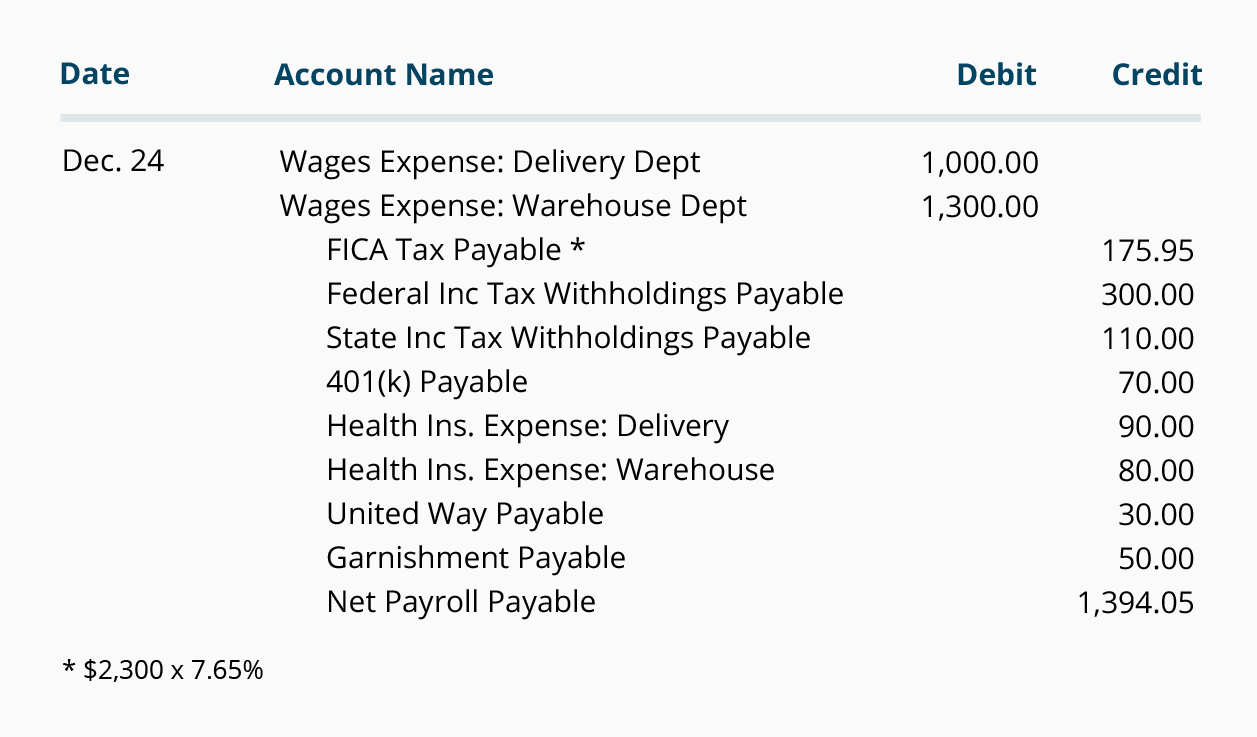
For the workweek of December 18-24, the gross wages are $1,000 for hourly employees in the delivery department and $1,300 for employees in the warehouse. Tax withholdings are determined by consulting government payroll guidelines; other withholdings are based on agreements with employees and court orders. Paychecks are dated and distributed on December 29.
The journal entry to record the hourly payroll's wages and withholdings for the work period of December 18-24 is illustrated in Hourly Payroll Entry #1. In accordance with accrual accounting and the matching principle, the date used to record the hourly payroll is the last day of the work period.
Hourly Payroll Entry #1: To record hourly-paid employees' wages and withholdings for the workweek of December 18-24 that will be paid on December 29.
20X-journal-01
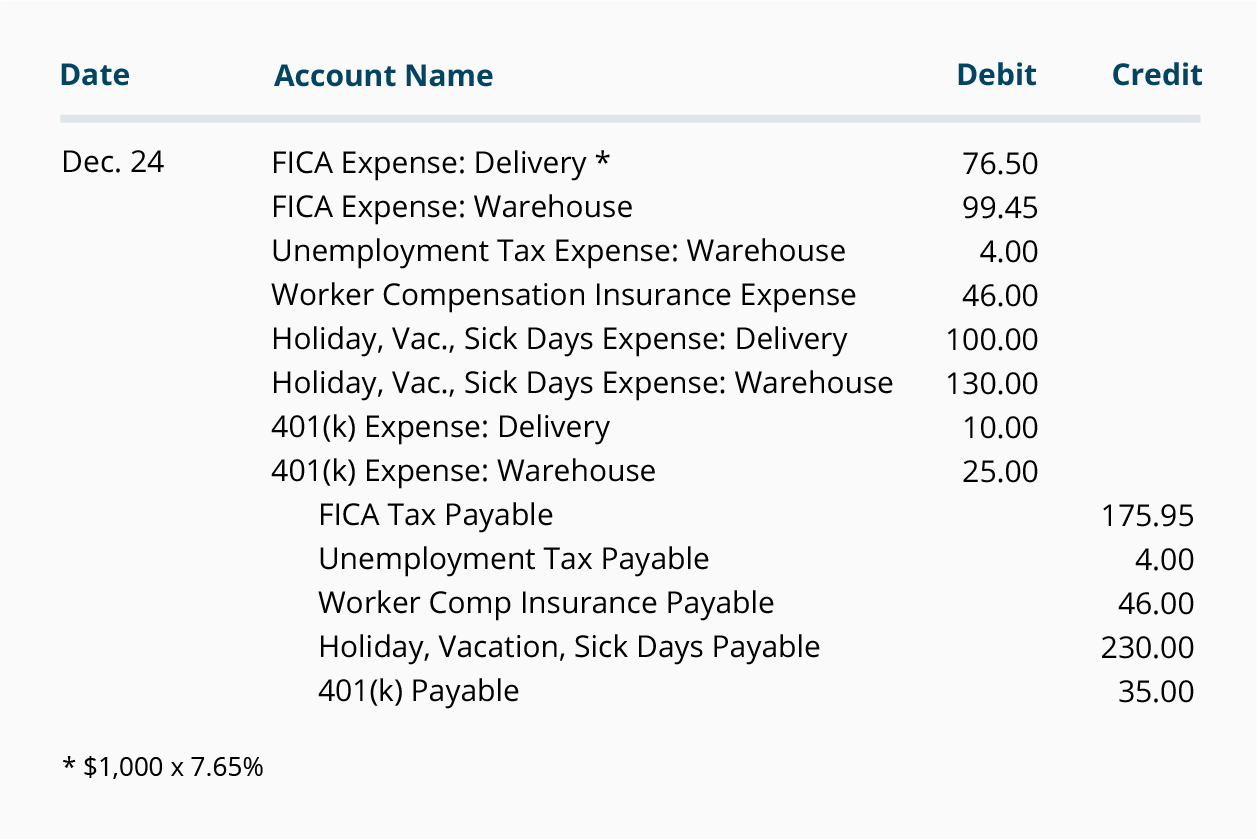
In addition to the wages and withholdings in the above entry, the employer has incurred additional expenses that pertain to the above workweek. These are shown next in Hourly Payroll Entry #2, which is also dated the last day of the work period. The items included are the employer's share of FICA, the employer's estimated cost for unemployment tax, worker compensation insurance, compensated absences, and company contributions for the company's 401(k) plan. The company is recognizing these additional expenses and the related liability in the period in which the employees are working and earning them. Later, when the company pays for them, it will reduce the liability and reduce its cash. (Our journal entry assumes that this company does not provide post-retirement benefits—like pensions or health insurance—to its employees.)
Hourly Payroll Entry #2: To record the company's additional payroll-related expense for hourly-paid employees for the workweek of December 18-24.
20X-journal-02
On payday, December 29, the checks will be distributed to the hourly-paid employees. The following entry will record the issuance of those payroll checks.
Hourly Payroll Entry #3: To record the distribution of the hourly-paid employees' payroll checks on Dec. 29. (These checks reflect the net pay for the wages earned during the workweek of Dec. 18-24).
20X-journal-03
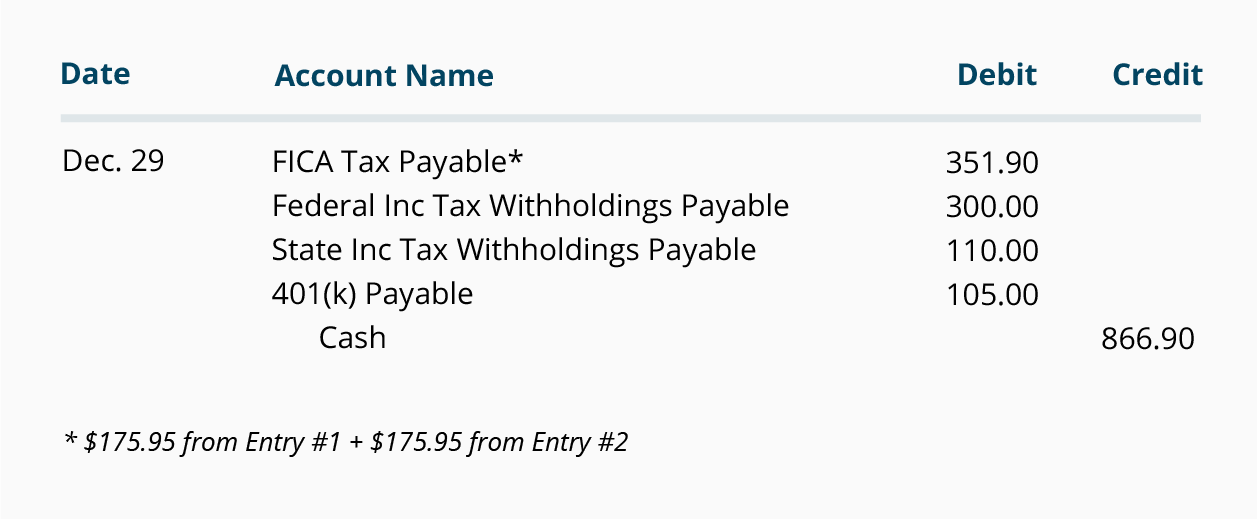
Some withholdings and the employer's portion of FICA were remitted on payday; others are not due until a later date. Some withholdings, such as health insurance, were recorded as reductions of the company's expenses in Hourly Payroll Entry #1. We will assume the amounts in the following Hourly Payroll Entry #4 were remitted on payday.
Hourly Payroll Entry #4: To record the remittance of some of the payroll withholdings and company matching pertaining to the hourly-paid workweek of Dec. 18-24.
20X-journal-04
End of Month and End of Year
Let's continue with our example of the payroll for the hourly-paid employees. We'll assume that this distributor's accounting month and accounting year both end on Saturday, December 31. The matching principle requires the company to report all of its December expenses (not simply its cash payments) on its December financial statements. This means the company must report on its income statement the hourly wages and other payroll expenses that the company incurred (and the employees earned) through December 31.
Recall that the paychecks issued on December 29 covered the work done by hourly employees through December 24. The company must now record the cost of work done during the week of December 25-31 (a week that includes a Christmas holiday plus a number of employees taking vacation days).
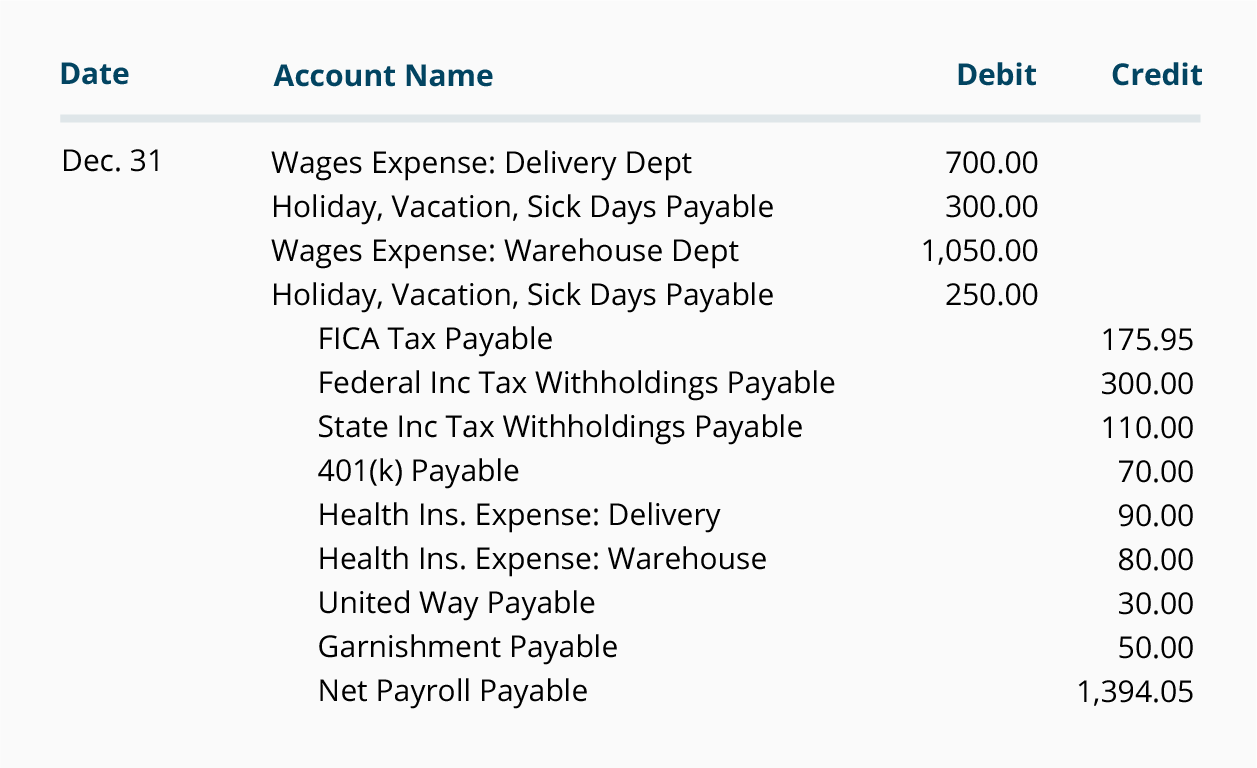
Let's assume that during the workweek of December 25-31, delivery department employees took $300 worth of their holiday and vacation days. Since a portion of the employer's estimated cost of holiday and vacation days was recorded as an expense and liability via each week's Hourly Payroll Entry #2, the $300 associated with the days actually taken this week will not be recorded as an expense—rather, the $300 associated with the days taken this week will reduce the liability that is recorded with each week's Hourly Payroll Entry #2. In other words, only $700 of the delivery department's employee gross wages of $1,000 is for the work performed this week. The warehouse department had a similar situation. Of the warehouse department's $1,300 of weekly wages, only $1,050 is the expense for the work performed this week. The wages associated with the "days off with pay" reduces the company's liability that was provided for each week in Hourly Payroll Entry #2. Except for the holiday and vacation days, the workweek payroll for December 25-31 is similar to the previous week.
Hourly Payroll Entry #1: To record hourly-paid employees' wages and withholdings for the workweek of December 25-31 that will be paid on January 5.
20X-journal-05
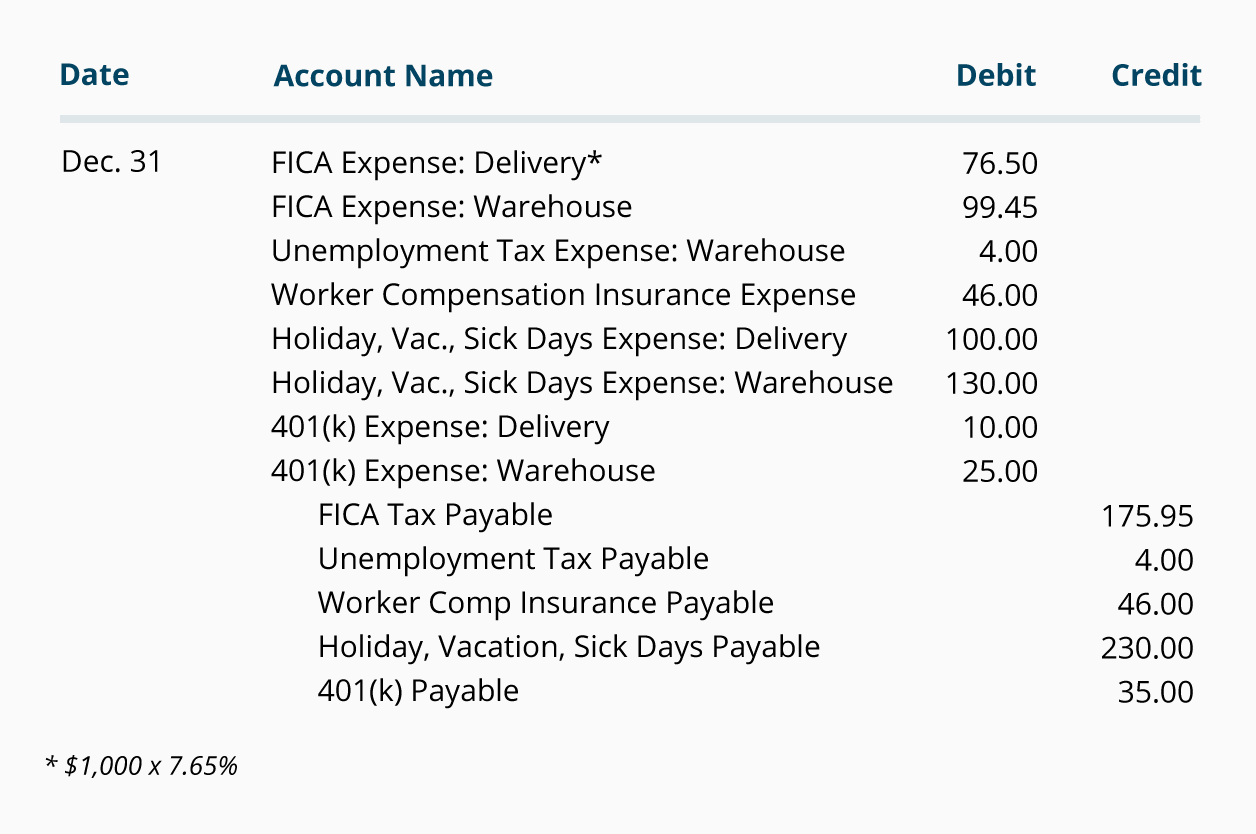
In addition to the wages and withholdings in Hourly Payroll Entry #1, the employer has incurred additional expenses that pertain to the above workweek. These are shown next in Hourly Payroll Entry #2, which is also dated the last day of the work period. The items included are the employer's share of FICA, the employer's estimated cost for unemployment tax, worker compensation insurance, compensated absences, and company contributions for the company's 401(k) plan. The company is recognizing these additional expenses and the related liability in the period in which the employees are working and earning them. Later, when the company pays for them, it will reduce the liability and reduce its cash. (Our journal entry assumes that this company does not provide post-retirement benefits-like pensions or health insurance-to its employees.)
Hourly Payroll Entry #2: To record the company's additional payroll-related expense for hourly-paid employees for the workweek of December 25-31.
20X-journal-06
On payday, January 5, the checks will be distributed to the hourly-paid employees. The following entry will record the issuance of those payroll checks.
Hourly Payroll Entry #3: To record the distribution of the hourly-paid employees' payroll checks on Jan 5. (These checks reflect the hourly-paid employees' take home pay from their wages earned during the workweek of Dec. 25-31).
20X-journal-07
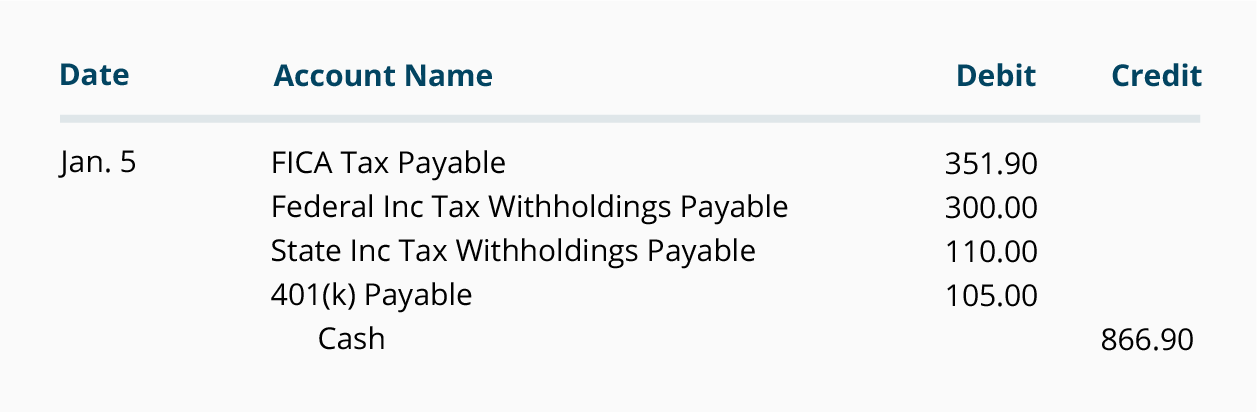
Some withholdings and the employer's portion of FICA were remitted on payday; others are not due until a later date. Some withholdings, such as health insurance, were recorded as reductions of the company's expenses in Hourly Payroll Entry #1. We will assume the amounts in the following Payroll Entry #4 were remitted on payday.
Hourly Payroll Entry #4: To record the remittance of some of the payroll withholdings and company matching pertaining to the hourly-paid workweek of Dec. 25-31.
20X-journal-08
Additional Accrual of Wages
In our example above, the workweek ended on the same day as the calendar month and year: December 31. In other months and in some years, the last full workweek might end on the 28th of the month. In that case, the employer will need to estimate the payroll and payroll-related expenses for the 29th, 30th, and 31st days of the month. Those estimates will be used to record an accrual-type adjusting entry on the 31st. This is required so that all of the expenses actually occurring during the month are matched with the revenues of the month. Recording wages expense in the proper period is critical for accurate financial statements and therefore a very important part of payroll accounting.
Examples of Payroll Journal Entries For Wages

NOTE: In the following examples we assume that the employee's tax rate for Social Security is 6.2% and that the employer's tax rate is 6.2%. (During the years 2011 and 2012 only, the employee's rate was reduced to 4.2%.)
In this section of payroll accounting we will provide examples of the journal entries for recording the gross amount of wages, payroll withholdings, and employer costs related to payroll.

Examples of Payroll Journal Entries For Salaries

Note: In the following examples we assume that the employee's tax rate for Social Security is 6.2% and that the employer's tax rate is 6.2%. (During 2011 and 2012 only, the employee's rate was reduced to 4.2%.)
Let's assume our company also has salaried employees who are paid semimonthly on the 15th and the last day of each month. The pay period for these employees is the half-month that ends on payday. There is one salaried employee in the warehouse department with a gross salary of $48,000 per year, or $2,000 per pay period. There are four salaried employees in the Selling & Administrative Department with combined salaries of $9,000 per pay period.


Because the salaried employees are paid on the last day of the month and their pay period ends right on payday, there is no need to accrue for salaries at the end of December (or any other calendar month). The salaried payroll entry for the work period of December 16-31 will be dated December 31 and will look like this:
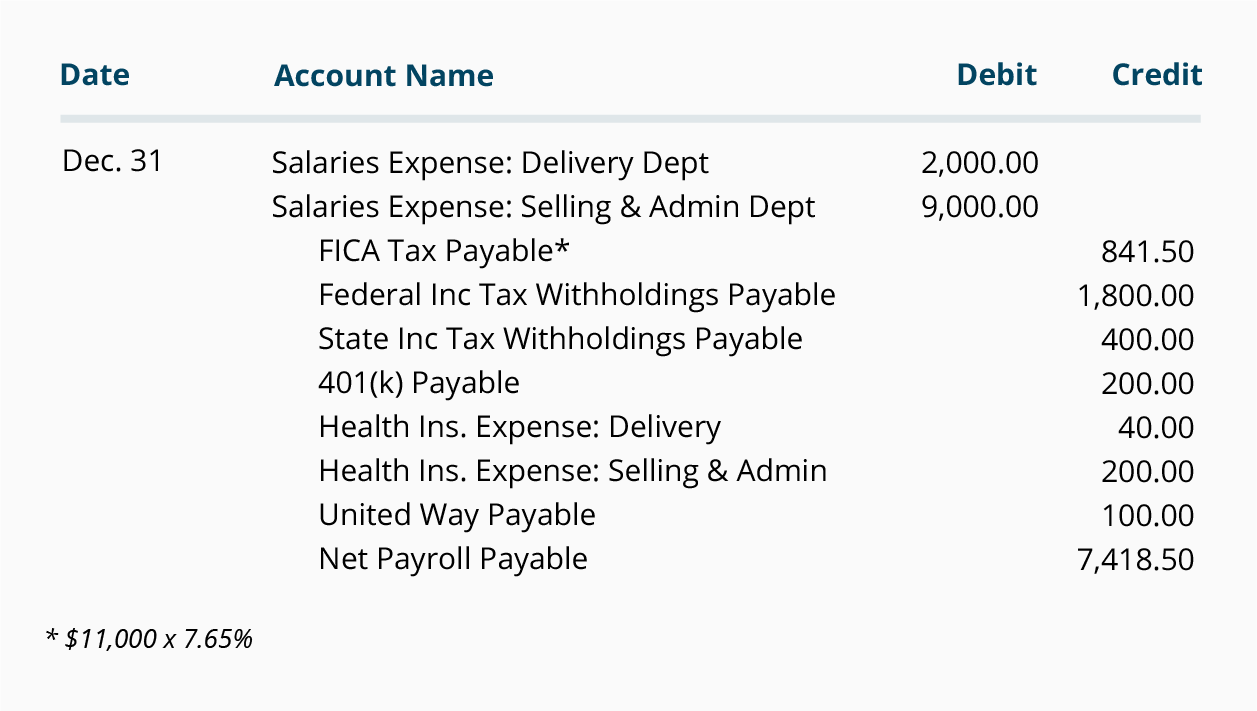
Salaried Payroll Entry #1: To record the salaries and withholdings for the work period of December 16-31 that will be paid on December 31.
20X-journal-09
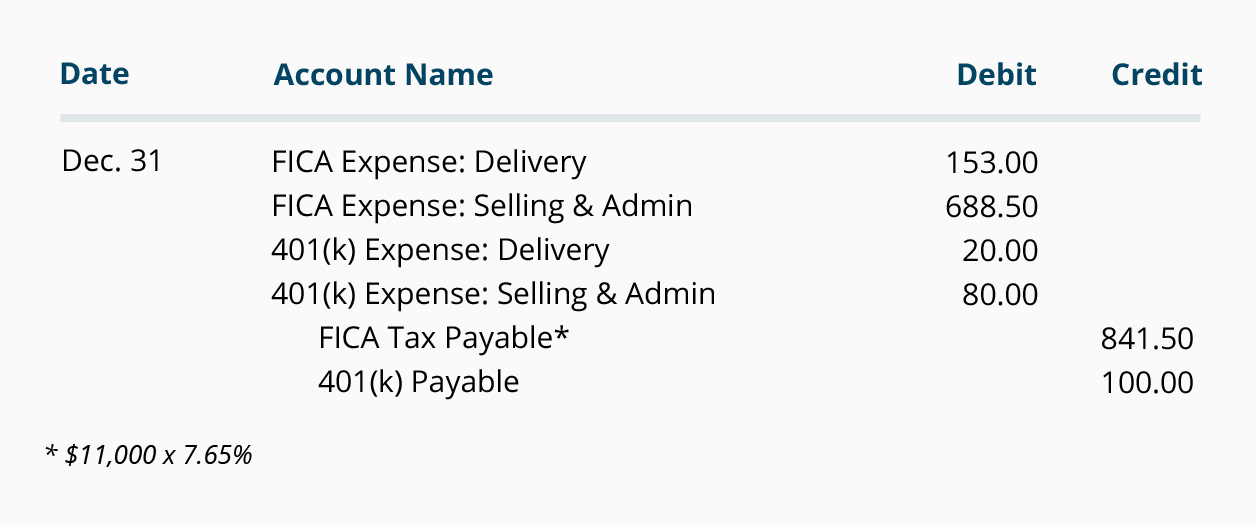
In addition to the salaries recorded above, the company has incurred additional expenses pertaining to the salaried payroll for this semi-monthly period of December 16-31. These expenses must be included in the December financial statements, as shown in the next journal entry:
Salaried Payroll Entry #2: To record additional payroll-related expense for salaried employees for the work period of December 16-31.
20X-journal-10
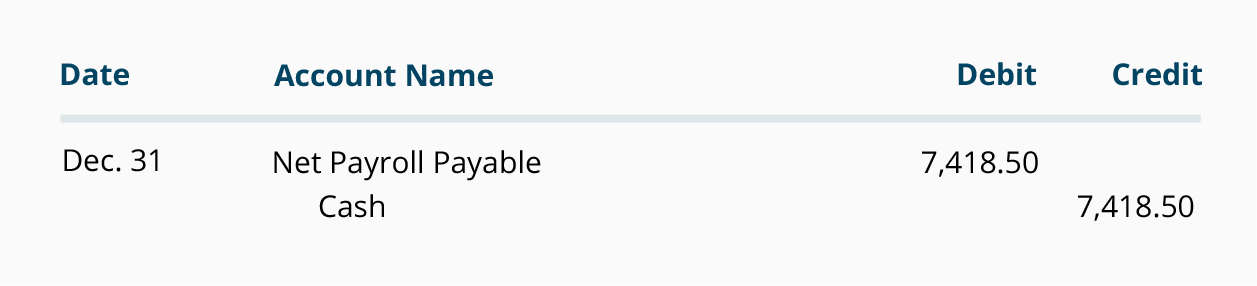
On payday, December 31, the checks will be distributed to the salaried employees. The following entry will record the issuance of those payroll checks.
Salaried Payroll Entry #3: To record the distribution of the salaried employees' payroll checks on Dec. 31. (These checks reflect the take-home pay for the salaries earned during the work period of Dec. 16-31).
20X-journal-11
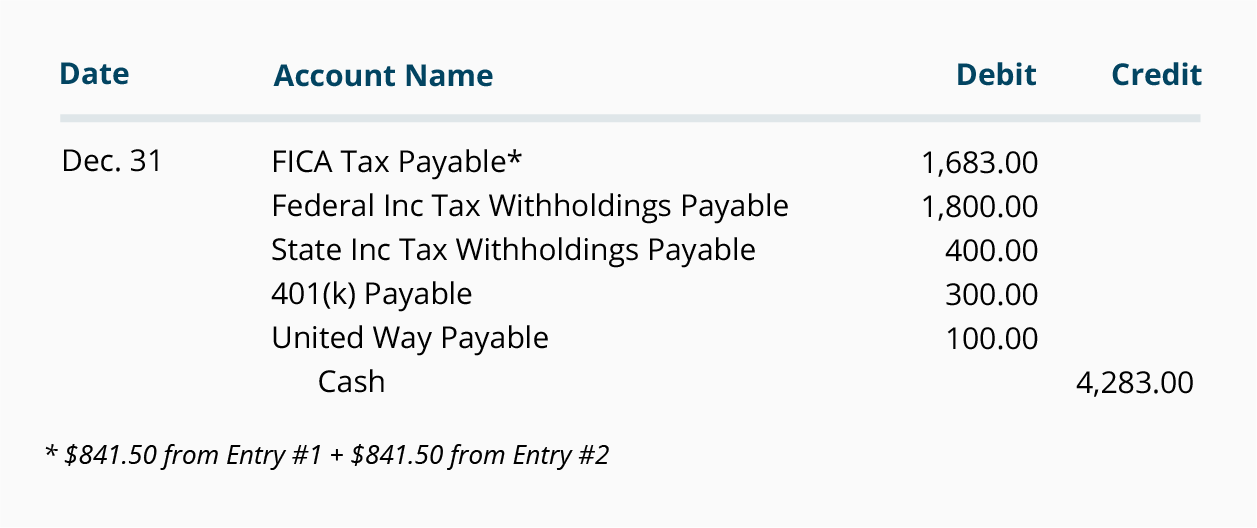
Some withholdings and the employer portion of FICA were remitted on payday; others are not due until a later date. Some withholdings, such as health insurance, were recorded as reductions of the company's expenses in Salaried Payroll Entry #1. We will assume the amounts in the following Payroll Entry #4 were remitted on payday.
Salaried Payroll Entry #4: To record the remittance of some of the payroll withholdings and company matching pertaining to the salaried employees during the work period of Dec. 15-31.
20X-journal-12

Additional Information and Resources

Because the material covered here is considered an introduction to this topic, many complexities have been omitted. You should always consult with an accounting professional for assistance with your own specific circumstances.

Sample Transactions #4 - #6

Sample Transaction #4

The fourth transaction occurs on December 3, when a customer gives Direct Delivery a check for $10 to deliver two parcels on that day. Because of double entry, we know there must be a minimum of two accounts involved—one of the accounts must be debited, and one of the accounts must be credited.

Because Direct Delivery received $10, it must debit the account Cash. It must also credit a second account for $10. The second account will be Service Revenues, an income statement account. The reason Service Revenues is credited is because Direct Delivery must report that it earned $10 (not because it received $10). Recording revenues when they are earned results from a basic accounting principle known as the revenue recognition principle. The following tip reflects that principle.

Here's a Tip

Revenues accounts are credited when the company earns a fee (or sells merchandise) regardless of whether cash is received at the time.
Here are the two parts of the transaction as they would look in the general journal format:
60X-journal-05

Sample Transaction #5

Let's assume that on December 3 the company gets its second customer-a local company that needs to have 50 parcels delivered immediately. Joe's price of $250 is very appealing, so Joe's company is hired to deliver the parcels. The customer tells Joe to submit an invoice for the $250, and they will pay it within seven days.
Joe delivers the 50 parcels on December 3 as agreed, meaning that on December 3 Direct Delivery has earned$250. Hence the $250 is reported as revenues on December 3, even though the company did not receive any cash on that day. The effort needed to complete the job was done on December 3. (Depositing the check for $250 in the bank when it arrives seven days later is not considered to take any effort.)
Let's identify the two accounts involved and determine which needs a debit and which needs a credit.
Because Direct Delivery has earned the fees, one account will be a revenues account, such as Service Revenues. (If you refer back to the last TIP, you will read that revenue accounts—such as Service Revenues—are usually credited, meaning the second account will need to be debited.)
In the general journal format, here's what we have identified so far:
60X-journal-06
We know that the unnamed account cannot be Cash because the company did not receive money on December 3. However, the company has earned the right to receive the money in seven days. The account title for the money that Direct Delivery has a right to receive for having provided the service is Accounts Receivable (an asset account).
60X-journal-07
Again, reporting revenues when they are earned results from the basic accounting principle known as the revenue recognition principle.

Sample Transaction #6

For simplicity, let's assume that the only expense incurred by Direct Delivery so far was a fee to a temporary help agency for a person to help Joe deliver parcels on December 3. The temp agency fee is $80 and is due by December 12.
If a company does not pay cash immediately, you cannot credit Cash. But because the company owes someone the money for its purchase, we say it has an obligation or liability to pay. Most accounts involved with obligations have the word "payable" in their name, and one of the most frequently used accounts is Accounts Payable. Also keep in mind that expenses are almost always debited.
The accounts and amounts for the temporary help are:
60X-journal-08

Here's a Tip

Expenses are (almost) always debited.

Here's a Tip

If a company does not pay cash right away for an expense or for an asset, you cannot credit Cash. Because the company owes someone the money for its purchase, we say it has an obligation or liability to pay. The most likely liability account involved in business obligations is Accounts Payable.
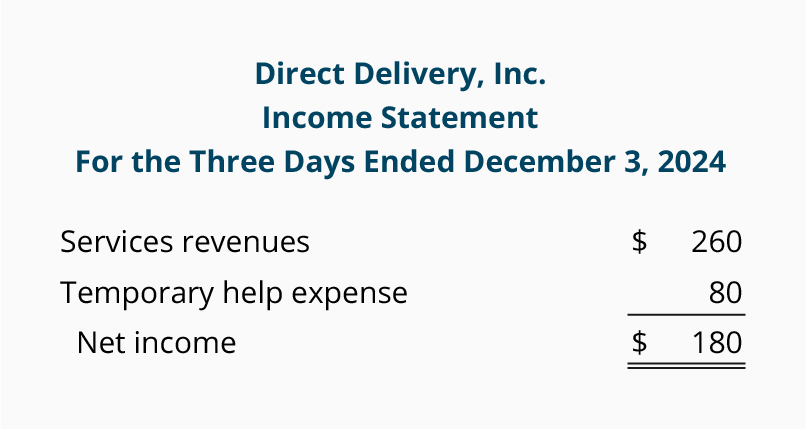
Revenues and expenses appear on the income statement as shown below:
60X-table-04
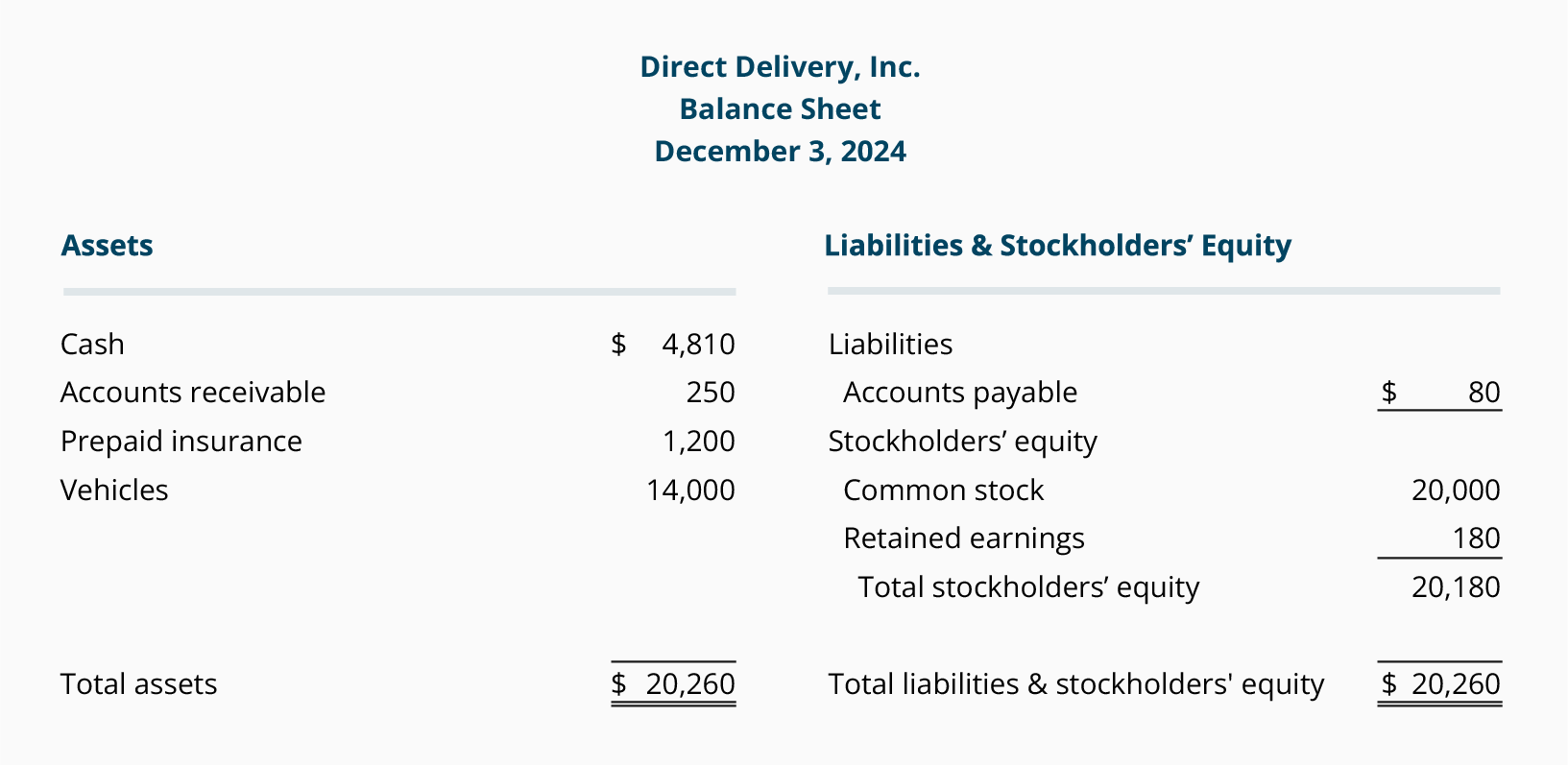
After the entries through December 3 have been recorded, the balance sheet will look like this:
60X-table-05
Notice that the year-to-date net income (bottom line of the income statement) increased Stockholders' Equity by the same amount, $180. This connection between the income statement and balance sheet is important. For one, it keeps the balance sheet and the accounting equation in balance. Secondly, it demonstrates that revenues will cause the stockholders' equity to increase and expenses will cause stockholders' equity to decrease. After the end of the year financial statements are prepared, you will see that the income statement accounts (revenue accounts and expense accounts) will be closed or zeroed out and their balances will be transferred into the Retained Earnings account. This will mean the revenue and expense accounts will start the new year with zero balances—allowing the company "to keep score" for the new year.
Marilyn suggested that perhaps this introduction was enough material for their first meeting. She wrote out the following notes, summarizing for Joe the important points of their discussion:
  1. When a company pays cash for something, the company will credit Cash and will have to debit a second account. Assuming that a company prepares monthly financial statements—
  2. When a company receives cash, the company will debit Cash and will have to credit another account. Assuming that a company will prepare monthly financial statements—
    • If the amount received is from a cash sale, or for a service that has just been performed but has not yet been recorded, the account to be credited is a revenue account such as Service Revenues or Fees Earned.
    • If the amount received is an advance payment for a service that has not yet been performed or earned, the account to be credited is Unearned Revenue.
    • If the amount received is a payment from a customer for a sale or service delivered earlier and has already been recorded as revenue, the account to be credited is Accounts Receivable.
    • If the amount received is the proceeds from the company signing a promissory note, the account to be credited is Notes Payable.
    • If the amount received is an investment of additional money by the owner of the corporation, a stockholders' equity account such as Common Stock is credited.
    Note: To learn more about debits and credits, go to Explanation of Debits and Credits and Quiz for Debits and Credits.
  3. Revenues are recorded as Service Revenues or Sales when the service or sale has been performed, notwhen the cash is received. This reflects the basic accounting principle known as the revenue recognition principle.
  4. Expenses are matched with revenues or with the period of time shown in the heading of the income statement, not in the period when the expenses were paid. This reflects the basic accounting principle known as the matching principle.
  5. The financial statements also reflect the basic accounting principle known as the cost principle. This means assets are shown on the balance sheet at their original cost or less and not at their current value. The income statement expenses also reflect the cost principle. For example, the depreciation expense is based on the original cost of the asset being depreciated and not on the current replacement cost.

Additional Information and Resources

Because the material covered here is considered an introduction to this topic, many complexities have been omitted. You should always consult with an accounting professional for assistance with your own specific circumstances.